
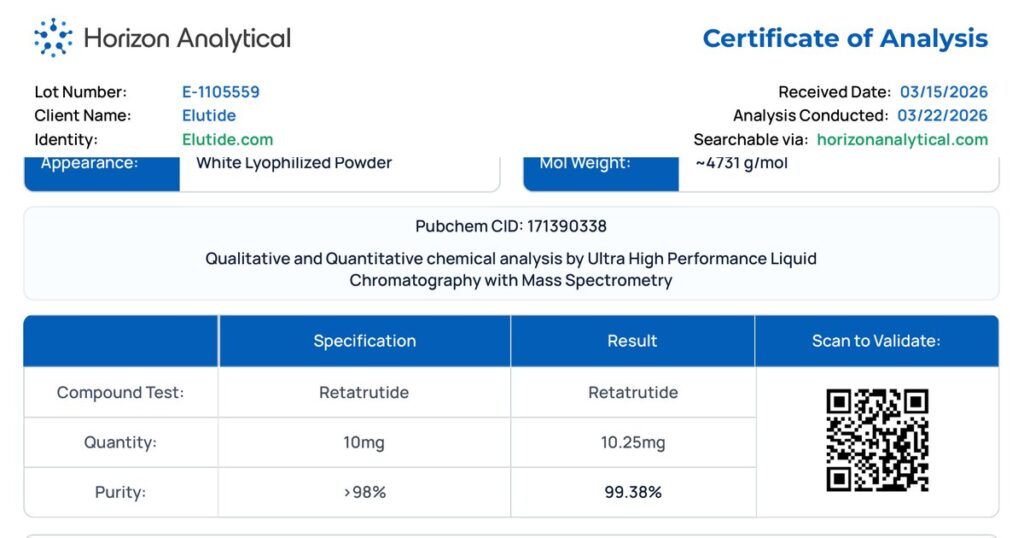
COAs are built for analytical chemists. If you’ve ever opened one and thought “I see numbers, but what do they actually mean?” — you’re in the right place. We’re going to walk through a real Elutide COA section by section, using an actual batch of BPC-157, Lot E-1105559, tested by Horizon Analytical.
No jargon walls. No chemistry degree required. Just a clear breakdown of what every part means and what you should pay attention to. View the full COA referenced in this guide (PDF) →
Section 1: The Header
Who tested it, when, and for whom

The header is your first trust check. It tells you three things immediately: the laboratory that performed the testing, the client who commissioned it, and when the analysis happened.
| Field | What It Means |
|---|---|
| Laboratory Name | The independent lab that performed the analysis. Should be a third-party facility — not the supplier’s own in-house lab. Elutide uses Horizon Analytical, a US-accredited laboratory. |
| Lot Number | The unique batch identifier. This should match the lot number on your product label. If it doesn’t, something is wrong. |
| Client Name | The company that submitted the sample. Confirms the supplier actually sent their product to a lab — not just downloaded a template. |
| Received / Conducted Dates | When the lab received the sample and when testing was performed. Confirms the analysis is recent and relevant to your batch. |
Section 2: Compound Identity
Confirming the peptide is what it claims to be

This section is the compound’s fingerprint. It confirms exactly what molecule was tested and gives you chemical identifiers to cross-reference in scientific databases.
| Field | What It Means |
|---|---|
| Compound | The peptide name. Should match what you ordered. |
| Lot | Batch identifier. Should match your product label and the header above. |
| Appearance | Physical description. Most research peptides arrive as a white lyophilized (freeze-dried) powder. Discoloration can indicate degradation. |
| CAS Number | A globally unique chemical identifier. Look it up on PubChem to verify the compound independently. |
| Molecular Formula | The exact atomic composition. For BPC-157: C62H98N16O22 — a 15-amino-acid pentadecapeptide. |
| Molecular Weight | Mass per molecule in g/mol. Used in mass spectrometry to confirm identity — the detected mass should match. |
Section 3: Test Results
The numbers that matter most
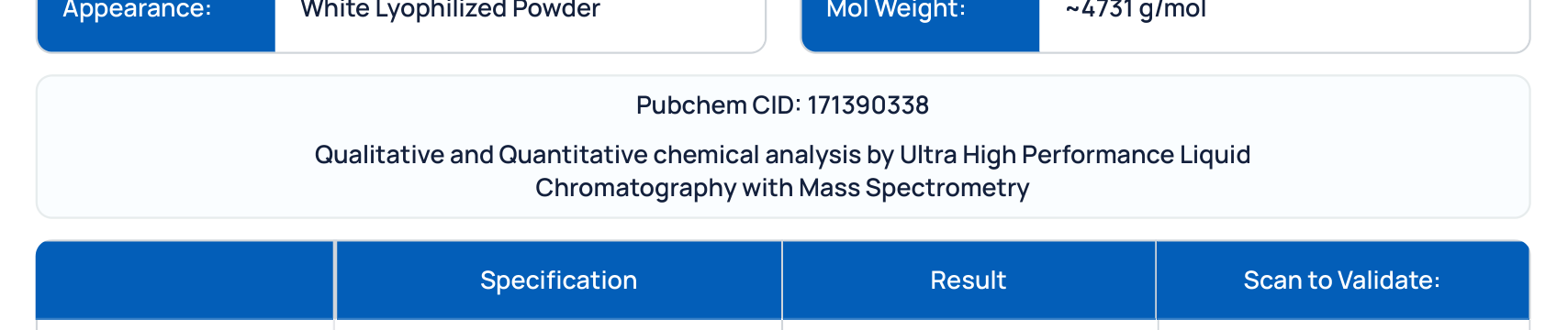
The core of the document. The methodology statement tells you what analytical techniques were used, and the results grid gives you the actual numbers.
| Field | What It Means |
|---|---|
| Testing Methodology | The analytical techniques used. This COA uses UPLC with Mass Spectrometry — the gold standard for peptide analysis. |
| Compound Test | Identity confirmation. Spec and result should match — “BPC-157” in, “BPC-157” out. |
| Quantity | Labeled amount vs. actual. This batch specified 10mg and tested at 10.25mg — slightly over-filled, which is ideal. |
| Purity | The big one. What percentage is actually your target compound. Spec >98%, result 99.38%. Higher is better. Below 95% warrants scrutiny. |
| QR Code | Scan to verify the COA directly with the lab. One of the strongest authenticity features a COA can have — confirms the document is real, not fabricated. |
Section 4: UPLC Chromatogram
The visual proof of purity
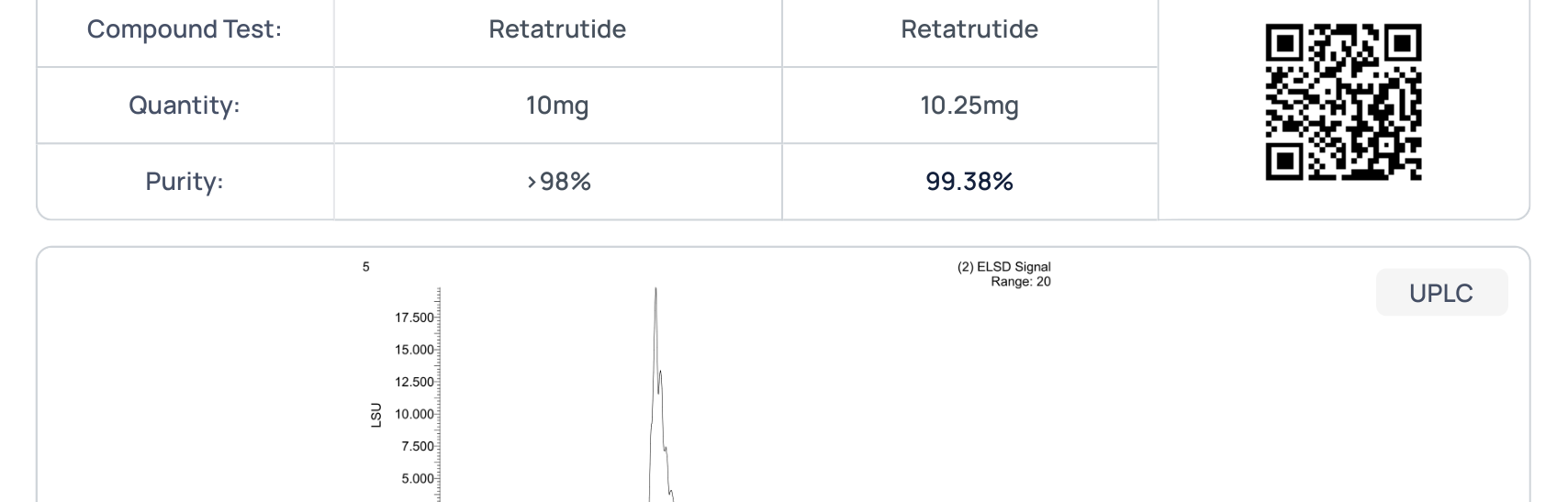
If purity is a number, the chromatogram is the picture that proves it. UPLC separates the sample’s components and measures each one individually. The simple version: the sample gets pushed through a column at high pressure, different molecules exit at different speeds, and a detector plots a peak for each one.
| What You See | What It Means |
|---|---|
| One tall, sharp peak | Your target compound. A single dominant peak means the vast majority of the sample is one substance. Exactly what you want. |
| Flat baseline | Very little noise or impurity in the sample. Clean baselines are good baselines. |
| X-axis (time) | Retention time in minutes. Each compound exits at a characteristic time, helping identify it. |
| ELSD label | Evaporative Light Scattering Detector — the detection method. It evaporates the liquid carrier and measures light scattered by remaining solid particles. |
Section 5: Mass Spectrometry (MS)
Molecular-level identity confirmation
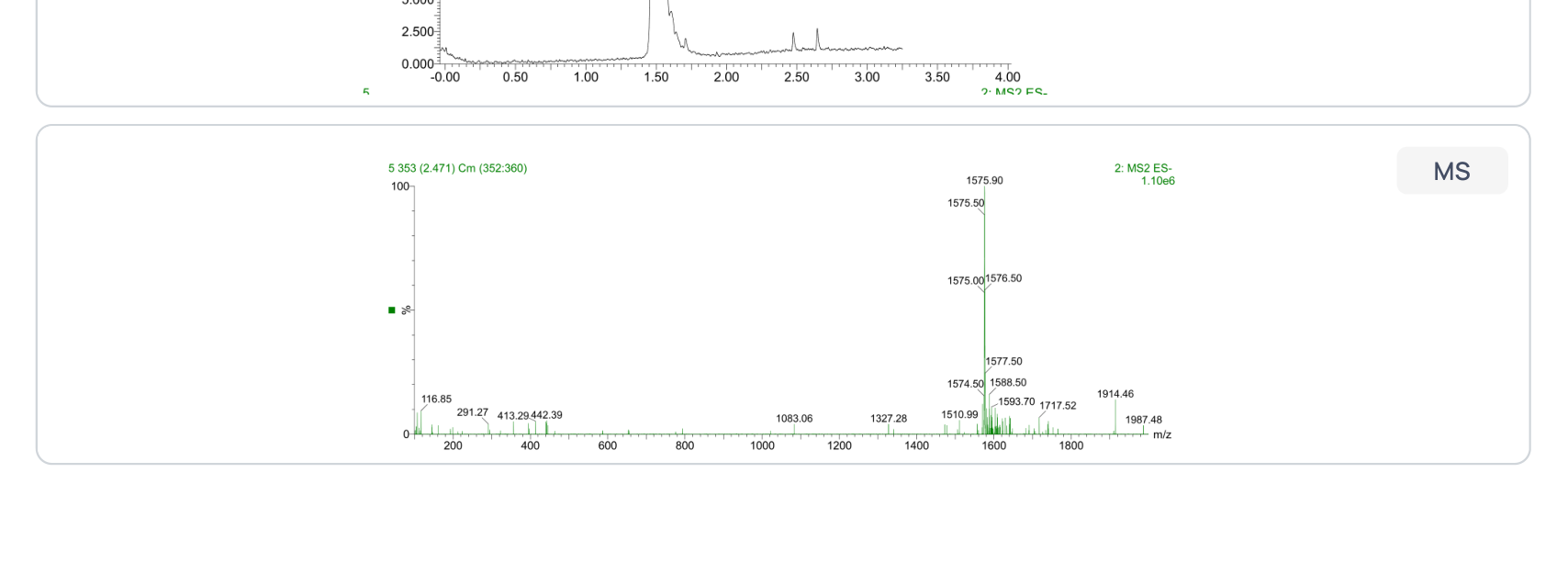
If UPLC answers “how pure is this?”, mass spectrometry answers “is this actually the right molecule?” It ionizes the compound and measures the mass-to-charge ratio (m/z) of the fragments. Think of it as a molecular weigh station — the machine sorts charged pieces by weight and plots what it finds.
| What You See | What It Means |
|---|---|
| m/z peak clusters | Each peak is a molecular fragment at a specific mass-to-charge ratio. Dominant peaks should match the compound’s expected molecular weight. |
| Multiple charge states | Peptides like BPC-157 (~1419 g/mol) can carry multiple charges during mass spectrometry analysis. The detected mass-to-charge ratios confirm the molecular identity. Normal and expected. |
| Peak cluster pattern | A clean, well-defined cluster at the expected m/z range confirms identity. The spacing between peaks corresponds to predictable isotope distribution. |
Section 6: Analyst Certification
The human behind the data
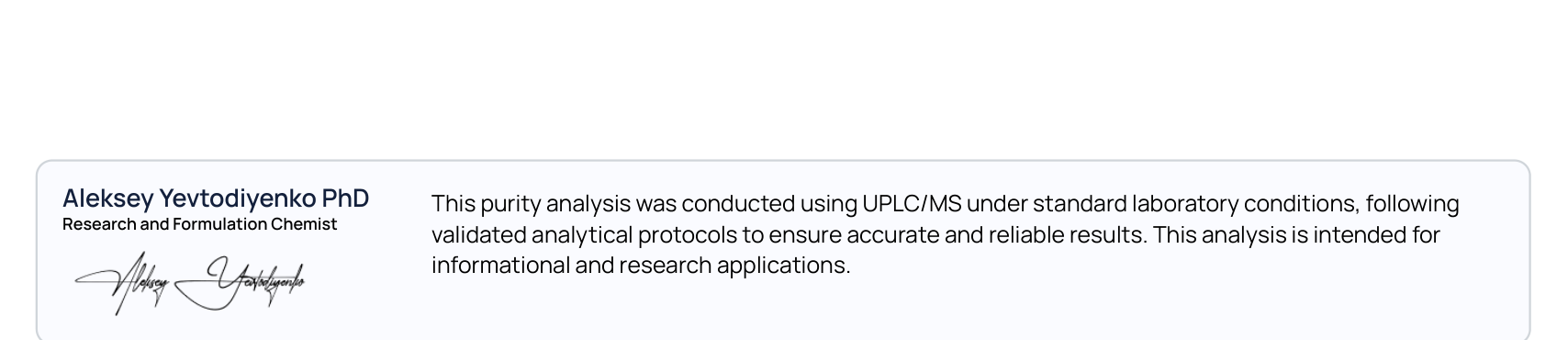
Every legitimate COA is signed by the analyst who performed or supervised the testing. This puts a real person — with real credentials — behind the results.
| Field | What It Means |
|---|---|
| Analyst Name & Title | The scientist who oversaw testing. Credentials (PhD, title) indicate expertise level. |
| Signature | Personal accountability for the results. The analyst stakes their professional reputation on these numbers. |
| Methodology Statement | Formal confirmation that proper procedures were followed under standard laboratory conditions. |
Red Flags: When a COA Might Not Be What It Seems
What should make you ask more questions
Not every COA is created equal. Here are the warning signs that separate real documentation from window dressing.
| Red Flag | Why It Matters |
|---|---|
| No lab name or “tested in-house” | Third-party testing removes the financial incentive to inflate results. |
| No chromatogram or spectrum | A purity number without supporting data can’t be verified. |
| Suspiciously round numbers | Real results have decimals. Exactly “99.00%” or “100%” should raise questions. Real testing gives you 99.38%. |
| No lot number | Without one, there’s no way to tie the COA to your specific batch. Could be reused across batches. |
| COA “available upon request” | Transparency issue. At Elutide, your COA ships with your order. Every time. |
| No QR code or verification link | Without one, you’re trusting the supplier’s word that the document is authentic. |
The Elutide Standard
Every batch is independently tested at Horizon Analytical. Every order ships with a full Certificate of Analysis — UPLC purity, mass spectrometry identity confirmation, and endotoxin screening. Not upon request. In the box. We publish every COA to our library and include a scannable QR code so you can verify results directly with the lab.
That’s not a marketing claim. That’s the minimum standard we think every peptide supplier should meet.
For Research Use Only. Not Intended for Human Consumption.
All Elutide products are intended for research purposes only. These products are not intended for human consumption, medical use, or as dietary supplements. They are not approved by the FDA.
This content is for educational purposes and does not constitute medical advice.
Related Research Peptides
Every Elutide peptide is independently tested at a US-accredited lab and ships with a full Certificate of Analysis. For Research Use Only. Not for human consumption.
- BPC-157 (HPLC verified)
- Tesa
- NAD+
- ELU-GP1-SG research peptide
- Browse all independently tested research peptides
Explore our independently tested research catalog
Every order below ships with the Certificate of Analysis this guide explains.
ELU-GP2-TZ · SS-31 · IGF-1 LR3 · Oxytocin · AHK-Cu · PT-141 · Melanotan-2 · BPC-157 / TB-500 Blend · L-Glutathione · B12 (Cyanocobalamin) · Lipo-C / MIC-B12 · 5-Amino-1MQ
All products are for Research Use Only. Not for human consumption.