
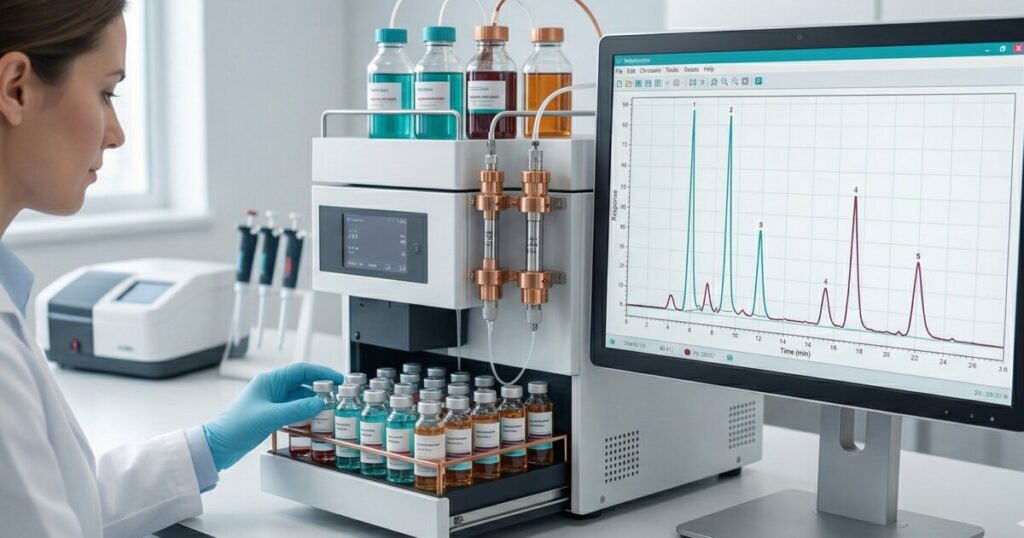
You Shouldn’t Have to Take Anyone’s Word for It.
Purity isn’t just a number on a spec sheet. It’s the difference between data you can trust and data you can’t. Every result you generate, every conclusion you draw — it all starts with what’s actually in the vial.
We built this guide because the research peptide market has a transparency problem. Too many suppliers treat Certificates of Analysis like fine print — optional, outdated, or generated in-house with no independent verification. We think you deserve better than “trust us.”
What’s Actually on a COA (And Why You Should Care)
A Certificate of Analysis is an independent lab report that confirms what’s in your vial. Not marketing. Not a promise. A documented, verifiable set of test results from people who have no stake in whether you hit “add to cart.”
Compound Identity
Mass spectrometry or HPLC confirms the peptide is exactly what the label says. No guesswork. No “equivalent” substitutions.
Purity Percentage
How much of the sample is the intended peptide versus impurities, salts, or synthesis byproducts. For research-grade, you want 95% or higher.
Moisture Content
Water content matters for peptide stability. Lyophilized products should come in under 5% to maintain integrity over time.
Related Substances
A breakdown of what’s in the other 2-5%. Known synthesis byproducts are normal. Unexpected chemicals? That’s your red flag.
Heavy Metals & Endotoxins
Screening for lead, cadmium, mercury, and bacterial endotoxins. These aren’t optional tests — they’re the ones that protect the integrity of sensitive research.
Lot Number & Lab Info
Which specific batch was tested, which lab did the work, and when. This is how you tie your experimental records back to verified source materials.
How to Read a COA Without a Chemistry Degree
It’s simpler than it looks. Start at the top — confirm the compound name matches your order. Then find the purity percentage. For research-grade peptides, 95% is the floor. Most of ours come in above 98%.
Scan the impurities section next. You’re looking for known synthesis byproducts (normal) versus anything unexpected (not normal). Then check the test date — a COA from a year ago doesn’t tell you much about what’s in your vial today.
Finally, look for the lab name and accreditation. ISO 17025 is the gold standard for analytical testing. If you don’t see it, ask questions.
At Elutide, the COA ships in your box. No hunting through email. No “request it from support.” Every order, every time. You can also browse them anytime in our COA Library.
Third-Party vs. In-House Testing
This is the part where a lot of peptide suppliers get quiet.
In-House Testing
The company selling the peptide tests it themselves. Fast? Sure. Cheap? Absolutely. But there’s an obvious conflict of interest when the people testing the product are the same people trying to sell it to you.
You’re trusting their word.
Independent Third-Party Testing
An accredited lab with zero financial stake in your purchase runs the analysis and issues the report. It costs more. It takes longer. And sometimes it uncovers problems manufacturers didn’t expect.
You’re trusting the data.
Elutide uses third-party labs exclusively. Every batch. No exceptions. If a batch fails testing, we source a new one. We’d rather delay a shipment than compromise your research.
What the Purity Numbers Actually Mean
You’ll see percentages thrown around a lot in this space. Here’s what they mean in practice.
The industry standard. 95% of the compound is your intended peptide, 5% is other substances (water, salts, synthesis byproducts). Suitable for the majority of research applications.
Tighter quality control during synthesis and purification. The jump from 95% to 98% is bigger than it sounds. Research requiring high sensitivity or very controlled conditions typically specifies this level.
Reserved for advanced chromatography, spectroscopy, or extremely sensitive assays. Significantly more expensive, and more than most applications require.
For most researchers, 95-98% from a reputable, independently tested supplier hits the sweet spot — quality you can trust without paying for purity you don’t need.
How We Handle Every Batch
No mystery. No hand-waving. Here’s the actual process from source to shipment.
Sourcing & Synthesis
We partner with established manufacturers who follow strict quality controls at every production stage — not just at the end.
Independent Lab Analysis
Every batch ships to a US-accredited third-party lab. HPLC for purity. Mass spec for identity. Endotoxin screening. We send multiple vials per batch — not just one.
COA Review & Batch Release
The lab generates an official Certificate of Analysis. We review it for completeness and accuracy. If anything doesn’t meet our standards, we reject the batch. Full stop.
Documentation Ships With You
Your COA goes in the box with your order. Not buried on a webpage. Not behind a support ticket. Right there, ready for your lab records.
What You Get From Elutide
Ready to See the Difference?
Browse our complete COA library, or explore the collection and see for yourself what independent testing and real transparency look like.
For Research Use Only. Not Intended for Human Consumption.
These products are intended strictly for research purposes in controlled laboratory environments. Elutide does not manufacture, distribute, or provide products for human consumption or any non-research use. All products are sold as reference standards for research and analytical purposes only.
Related Research Peptides
Every Elutide peptide is independently tested at a US-accredited lab and ships with a full Certificate of Analysis. For Research Use Only. Not for human consumption.
- BPC-157 (HPLC verified)
- Tesa
- NAD+
- ELU-GP1-SG research peptide
- Browse all independently tested research peptides
Explore our independently tested research catalog
Browse the tested catalog behind our purity standards.
ELU-GP2-TZ · SS-31 · IGF-1 LR3 · Oxytocin · AHK-Cu · PT-141 · Melanotan-2 · BPC-157 / TB-500 Blend · L-Glutathione · B12 (Cyanocobalamin) · Lipo-C / MIC-B12 · 5-Amino-1MQ
All products are for Research Use Only. Not for human consumption.